


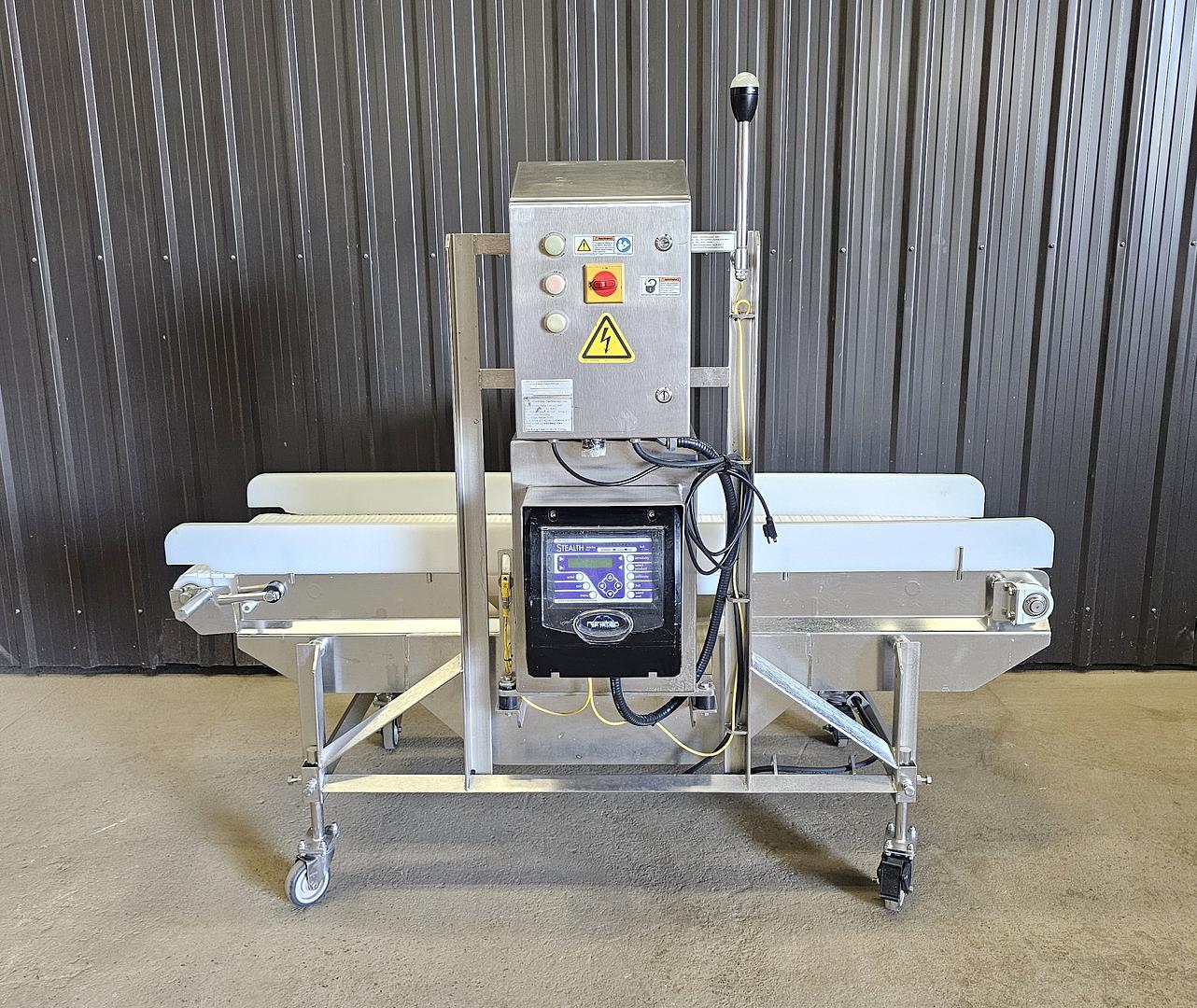
Metal Detectors in Food Processing: the key to risk mitigation
The essential takeaway: Effective metal detection is a non-negotiable safeguard for brand reputation and FDA or CFIA compliance, not merely a hardware requirements. Identifying Critical Control Points (CCPs) and utilizing multi-frequency technology are vital to minimizing false rejects and costly downtime. To support your risk mitigation strategy with reliable equipment, browse our inventory of metal detectors.
Can you trust your current metal detectors and food processing systems to prevent the catastrophic financial impact of a product recall or an audit failure? Implementing robust detection technology is not merely a regulatory obligation, but a strategic necessity to protect your brand reputation and secure downstream machinery. We examine the precise technical specifications and placement strategies required to ensure full FDA or CFIA compliance and effective risk mitigation.
More Than a Machine, It's Your First Line of Defense
Protecting Consumers and Your Brand's Reputation
A stray metal shard isn't just a defect; it’s a lawsuit waiting to happen. Physical contaminants cause severe internal injuries or choking hazards. That is the absolute bedrock of any serious food safety program.
But look at the bigger picture beyond one injury. A recall is a logistical nightmare that bleeds money fast. Distributors lose faith, and the public moves on. It’s a direct hit to your brand reputation.
Metal detection isn't optional anymore. It is fundamental risk mitigation.
Safeguarding Your Production Equipment
Let’s talk operations for a second. A rogue bolt can damage expensive downstream machinery, such as industrial grinders or slicers. Metal detectors and food processing units stop this damage cold.
That damage causes unplanned line stops and massive downtime. It kills your Total Cost of Ownership.
The Three Types of Metal You're Hunting For
Not all metals behave the same in a magnetic field. Your detector’s performance hinges entirely on what specific contaminant you are trying to catch.
- Ferrous metals: Magnetic and typically the easiest to detect.
- Non-ferrous metals: Includes aluminum, copper, and brass. Readily detectable.
- Stainless steel: Often the biggest challenge, especially non-magnetic grades commonly found in food processing machinery itself.
How the Technology Actually Works (and Where It Gets Tricky)
The Basics: Balanced Coils and Magnetic Fields
Let's look at the mechanics. A central transmitter broadcasts a radio-frequency signal, creating a specific electromagnetic field. Two receiver coils sit on either side, perfectly balanced. When metal passes through, it disturbs that equilibrium, triggering an immediate alert.
This three-coil arrangement powers the metal detectors used on food processing lines. It’s the engineering baseline keeping operations predictable and compliant.
The "Product Effect" Problem: When Good Food Looks Like Bad Metal
Here is the headache we call "product effect." Items with moisture or high salt content, like fresh meat or cheese, are naturally conductive. They mimic the signal of actual contaminants.
The detector misclassifies the food as a threat. This triggers false positives, resulting in the scrapping of perfectly safe products. That isn't just annoying; it is a direct, measurable hit to your yield and bottom line.
The Solution: Multi-Frequency Detection
Modern systems fight this by utilizing multi-frequency technology effectively. Instead of one signal, they scan the product across a spectrum simultaneously. It changes how the machine reads the data.
The system learns the food's specific "signature" and ignores it. Manufacturers like CEIA focus on this high level of interference immunity. You catch the metal, not the meat.
Strategic Placement for Maximum Impact
Identifying Your Critical Control Points (CCPs)
Effective contamination control isn't a guessing game; it requires strict adherence to HACCP protocols and the preventive control mandates of the FSMA and SFCR. You must position detection equipment at specific points where hazards can be prevented or reduced to acceptable levels, known as Critical Control Points (CCPs).
- At raw material intake: To catch contaminants before they enter your process and get broken into smaller, harder-to-find fragments.
- In-process: After stages like grinding or mixing, where machinery could introduce metal fragments. This has been identified as a CCP in studies.
- Final inspection (post-packaging): A final check to protect consumers and ensure the integrity of the finished product.
Proving Compliance: Validation, Testing, and Documentation
Let’s be real: you can’t just plug in metal detectors, food processing units, and walk away. That is a recipe for disaster. Validation isn't a one-time event; it is a relentless, continuous grind that demands attention.
You need a rigid schedule, hourly or every shift change, using certified test wands. We are talking ferrous, non-ferrous, and stainless steel samples. This is exactly what Honolulu Cookie Company tackled to ace their audit and meet strict BRC, SQF, and FDA ir CFIA demands.
The Non-Negotiable Routine: Regular Testing
Here is the hard truth: if you didn’t write it down, it simply didn’t happen. Auditors don’t care about your word; they care about your paper trail.
You must keep meticulous logs of every test, rejection, corrective action, and maintenance check. This data is your only proof of due diligence and regulatory compliance. It aligns perfectly with the Codex Alimentarius guidelines on validation for control measures.
Documentation Is Everything
Want to sleep at night? Ensure your setup hits these non-negotiables:
- Your system effectively handles "product effect" to prevent false rejects.
- It is correctly positioned at all identified CCPs.
- You have a strict, documented protocol for testing and calibration.
- Your team is fully trained on how to respond to a detection event.
These aren't just boxes to check; they determine if you survive the next surprise inspection. If your current line feels risky, it is time to upgrade. Take a look at Our inventory of metal detectors to see what compliant, reliable equipment looks like.
Reliable metal detection is a strategic necessity for risk mitigation. It goes beyond simple compliance; it safeguards your brand and ensures operational continuity. By implementing robust, FDA- or CFIA-compliant systems at critical control points, you protect your bottom line from costly recalls. Secure your facility with equipment proven to perform.
FAQ
Why is metal detection considered a Critical Control Point (CCP) in food processing?
In a robust HACCP plan, metal detection is often the last line of defense before a product reaches the consumer. Designating it as a CCP ensures a monitored, validated step that eliminates physical hazards, which is essential for meeting FDA and CFIA compliance standards and avoiding catastrophic recalls.
How do I prevent false rejects caused by the "product effect"?
Wet, salty, or iron-rich products can generate a signal that mimics metal, confusing older single-frequency machines and causing costly waste. To mitigate this, you need modern systems equipped with multi-frequency technology. These units can simultaneously filter out the product's signal while remaining highly sensitive to actual metallic contaminants.
Can industrial metal detectors reliably find stainless steel fragments?
Detecting stainless steel is the biggest challenge for any operations manager because many grades used in food processing machinery are non-magnetic. While ferrous and non-ferrous metals are easier to detect, you must specify equipment calibrated to detect stainless steel to ensure a broken machine part doesn't compromise your entire batch.
What is the difference between conveyor, gravity, and pipeline detection systems?
The choice depends entirely on your product flow and packaging state. Conveyor systems are standard for packaged goods; gravity-flow systems are critical for bulk powders or grains to maintain flow rates; and pipeline systems are engineered for pumped liquids and pastes. Selecting the wrong type will result in operational bottlenecks and reduced sensitivity.
How often should we test our metal detection equipment for validation?
Reliability is not a "set it and forget it" metric; it requires proof. Best practice dictates testing at the start of every shift, at regular intervals (e.g., hourly), and whenever product batches change. Documenting these tests with certified test pieces is non-negotiable for passing BRC or SQF audits and proving due diligence.